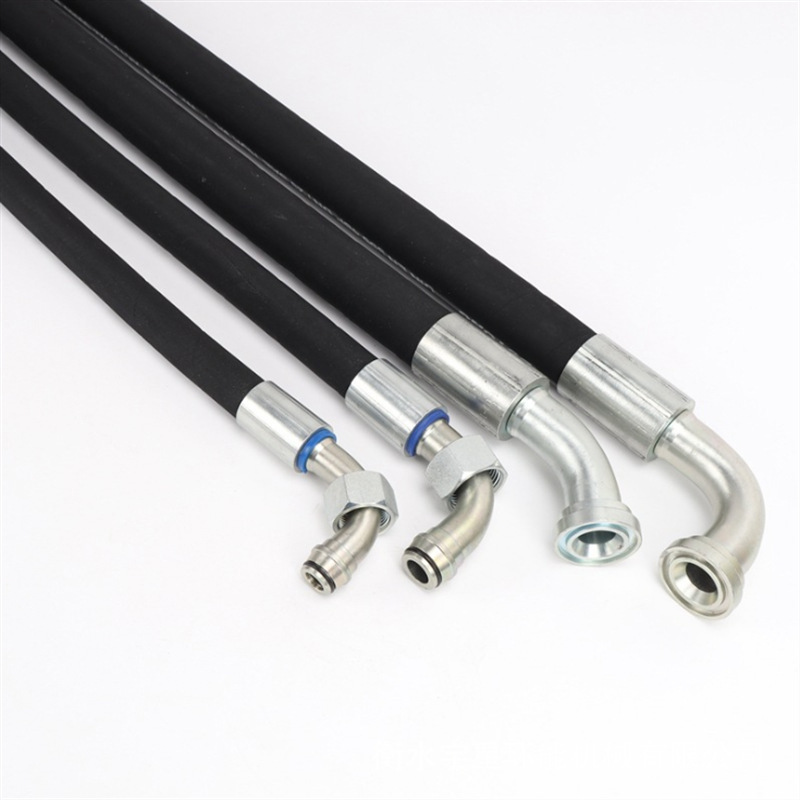
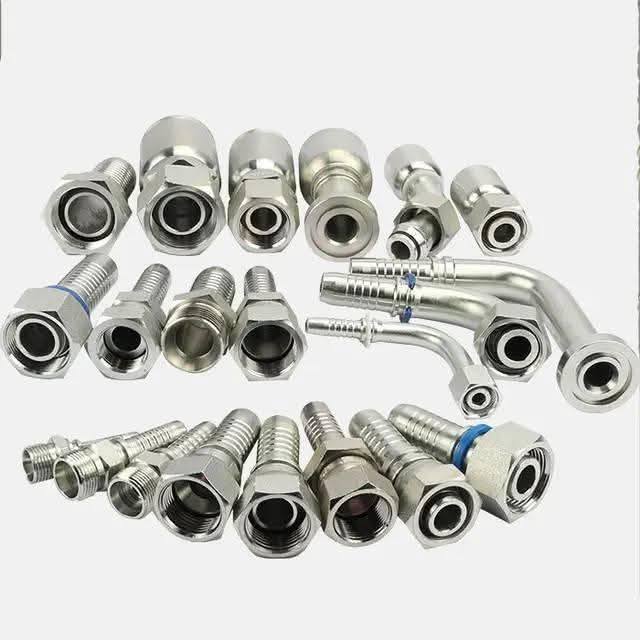
What are the standards for hydraulic hose fittings?
Read:
Hydraulic hose fittings, as key components connecting pipelines in hydraulic systems, directly affect the system's sealing performance, reliability, and safety due to their standardization. Currently, various standard systems for hydraulic hose fittings exist globally, primarily including international standards, national standards, industry standards, and enterprise standards. The following is a systematic overview and analysis of the standard systems for hydraulic hose fittings from different perspectives.
I. Mainstream International Standard Systems
1. ISO Standards
The hydraulic hose fitting standards developed by the International Organization for Standardization (ISO) are globally applicable and mainly include:
- ISO 8434 series: Covering 24° tapered compression fittings (ISO 8434-1), welded fittings (ISO 8434-2), and flared fittings (ISO 8434-3). The 24° tapered sealing structure is the mainstream choice in the engineering machinery field due to its ease of assembly and disassembly and high pressure resistance (up to 63MPa).
- ISO 12151 series: A standard for hose fitting connections, specifying the technical parameters for connection methods such as nut locking and flanged connections.
2. DIN Standards
German Industrial Standards (DIN) are known for their rigor. Typical standards include:
- DIN 2353: Specifies the dimensions and tolerances for compression fittings, divided into three series: light (L), medium (M), and heavy (S), with working pressures covering 16-63 MPa.
- DIN 3861: Applicable to flared fittings, requiring the flaring angle of the pipe end to be strictly controlled within 74°±1°.
3. SAE Standards
The Society of Automotive Engineers (SAE) standards dominate the North American market:
- SAE J514: Specifies 37° flared fittings, widely used in automotive hydraulic braking systems.
- SAE J1453: For O-ring flat seal fittings, emphasizing the oil resistance and compression set of the rubber material.
II. China's National Standards System my country's standards for hydraulic hose fittings are mainly formulated with reference to international standards, while also taking into account local needs:
1. GB/T Standards
- GB/T 3733~3765 series: Equivalent to ISO 8434, specifying the type and dimensions of ferrule fittings (e.g., GB/T 3737.1-2020).
- GB/T 5625-2008: Equivalent to DIN 2353 ferrule fitting standard, requiring the ferrule hardness to reach HRC58-64.
2. Industry-Specific Standards
- JB/T 966~970 series: For hydraulic quick-connect fittings in engineering machinery, specifying performance requirements within the nominal diameter range of 6-50mm.
- HG/T 20537-1992: Standard for stainless steel hydraulic hose fittings for the chemical industry, emphasizing that the material must pass the intergranular corrosion test.
III. Key Performance Indicators
1. Pressure Rating
Classified according to ISO 4397: Low pressure (≤6.3MPa), Medium pressure (6.3-25MPa), High pressure (25-42MPa), and Ultra-high pressure (>42MPa). Ultra-high pressure joints must pass a burst test at 2.5 times the working pressure.
2. Sealing Type
- Metal Seal: Such as a 24° conical seal (ISO 8434), relying on the plastic deformation of the metal to achieve sealing, requiring surface roughness Ra≤0.8μm.
- Elastomer Seal: O-rings according to ISO 3601 standard, oil resistance must meet IRM903 oil immersion volume change rate <10%.
3. Material Specifications
- Carbon steel connectors shall conform to the GB/T 699 standard for 45 steel;
- Stainless steel connectors shall conform to the ASTM A276 standard for 316L, with a chloride ion content of <25ppm;
- Sealing materials shall pass the compression set test of GB/T 7759.
IV. Special Application Standards
1. Explosion-proof Applications
Connectors conforming to ATEX 2014/34/EU standards must meet the following requirements:
- Surface resistivity <1×10⁹Ω;
- Anti-loosening design (e.g., double nut structure).
2. Food and Pharmaceutical Fields
- Materials must be certified by FDA 21 CFR 177.2600;
- The inner surface of the connector must be polished to Ra≤0.4μm.
3. Aerospace
According to AS5202 standards, the requirements are:
- 100% radiographic testing;
- Fatigue life >10⁶ pulse cycles.
V. Quality Control and Testing Standards
1. Factory Testing
- Airtightness Test: Pressure holding test at 1.5 times the working pressure according to ISO 5208;
- Flow Rate Test: Pressure drop not exceeding 0.1 MPa/10m (ISO 6605).
2. Type Testing
- Vibration Test: 20-2000Hz sweep frequency test according to ISO 10763;
- Salt Spray Test: No red rust after 500 hours of neutral salt spray (GB/T 10125).
VI. Development Trends
1. Lightweight Design
The new titanium alloy connector (TC4) is 40% lighter than traditional steel components and has been included in ASME B16.34-2023 Annex.
2. Intelligent Interface
ISO/TC131 is developing a standard for intelligent connectors with RFID tags, which can monitor the sealing status in real time.
3. Environmental Requirements The EU ErP Directive mandates that hydraulic hose fittings be free of PFAS coatings after 2026, promoting the development of uncoated stainless steel technology.
Understanding these standards is crucial for hydraulic system design and selection. It is recommended to prioritize products from companies with both ISO 9001 and ISO 14001 certifications in practical applications, and to regularly check for standard updates (e.g., ISO standards are reviewed every 5 years) to ensure compliance with the latest technical requirements. For special operating conditions, customized designs can be developed by referring to association standards such as VDMA 24582.